· Sales data · 7 min read
The Best SDR APIs for Lead Generation (2026)
Prospecting and contact data APIs for SDRs: how they charge, what a found result really costs, and coverage numbers from running identical input slices through 13 vendors.
One of the core tasks of Sales Development is prospecting and retrieving contact data. A large ecosystem of graphical tools exists for exactly this use case. Companies like Clay, Apollo, Amplemarket, and LeadIQ specialize in graphical tools.
In this blog post we're exploring prospecting APIs for SDRs and how well they play with agentic use cases.
Why APIs
Using an API has several advantages: the ability to integrate with tools like n8n or Zapier, as well as the ability to build internal tooling on top of it.
APIs also come with cost-saving potential, because they let you cut out a middleman whose main contribution is the user interface.
How APIs charge
Search APIs
Search APIs typically charge in one of three modes: per result, per page, or flat.
| Mode | You pay | Watch out for |
|---|---|---|
| Per result | each record a search returns | re-pulling the same records twice |
| Per page | each page of results, full or not | thin last pages cost as much as full ones |
| Flat | a fixed platform fee | paying while the API sits idle |
Across the search APIs we track, a returned result costs between $0.001 and about $0.03.

List prices per returned search result across the APIs we track. Most vendors sit near the low end; result quality, not price, is where they differ.
Contact data APIs
Contact data APIs typically charge when they successfully return a result. Only a few providers apply a flat per-request charge.
| Mode | You pay | Watch out for |
|---|---|---|
| On success | only when data comes back | what counts as "found" (catch-all emails do) |
| Per request | every call, hit or miss | misses cost as much as hits |
Per-request billing makes every delivered result 30-50% more expensive than the same list price billed on success.
A found work email costs between 1¢ and about 33¢ at list price. A found mobile number costs 8¢ to 96¢.
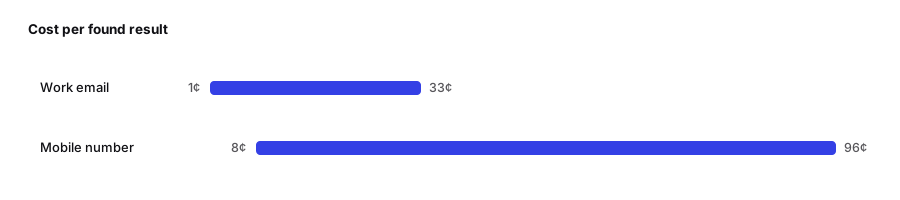
List prices per successfully returned result across the contact data APIs we track. Mobile numbers cost a multiple of work emails at every provider.
Search strategies
Prospecting APIs follow two strategies: a database strategy and an indexing strategy.
Database strategy
By far the most common strategy for search APIs is looking for matches in a static result database. This database is either owned by one provider, or a provider fans your request out across multiple databases and cleans up the result before serving it to you.
Providers that follow this strategy are People Data Labs and Crustdata.
Indexing strategy
A much newer strategy for prospecting is indexing. Providers like Parallel Web Systems or Exa build indexes over the entire internet. The big bet here is to become the "Google for agents".
Where Google meticulously filters its index to serve knowledge, not identities, new search providers noticed that letting companies build people and company lists from an internet-scale index is valuable in its own right.
Data from indexing does not derive from classical contact data aggregation. It comes from scanning the open web and making the result searchable.
Prospecting APIs
Single provider APIs
Single provider APIs serve a single dataset. This is the current industry standard. The API provides a search endpoint that you use to retrieve people data. You will find many companies claiming the highest coverage in this space.
Our testing shows there is no single best dataset. Datasets differ significantly in freshness and coverage depending on region, profession, and demographic.
The single-dataset search APIs we would look at, in order:
- pipe0: every search below is also available here, behind one interface
- Amplemarket: strong B2B profiles, and the dataset our own searches lean on heavily
- Crustdata: the freshness play, refreshed at lookup time
- People Data Labs: the bulk workhorse, priced per record
- Apollo: the budget entry, gated by plan
Multi provider APIs
Multi provider APIs are a newer concept. Here, the datasets of many different providers become available through one single API. Coverage is higher, and you get to learn the strengths and weaknesses of specific datasets instead of marrying one. This is especially useful for MCP servers, where an agent can compare datasets autonomously and reason about the best one for a given job.
It also has advantages for TAM sourcing: you can query all datasets simultaneously and build a list of the entire market you are trying to tackle.
As of this writing, pipe0 is the only provider that offers multi-dataset search through one API.
Contact data APIs
Single provider APIs
The same single-dataset pattern exists for contact data. Most of the well-known email finders work this way.
Single datasets are cheap and predictable, and they miss a lot. In our testing, a single contact dataset resolves anywhere between a fifth and three quarters of a list, depending on the task and your input.
No amount of marketing changes this. However, more datasets chained together into waterfalls do.
Waterfall APIs
Waterfall APIs chain multiple contact datasets behind one call: if the first dataset misses, the request falls through to the next. You pay only the dataset that delivered. We explained the mechanics in FullEnrich vs Clay.
The effect on coverage is not subtle. In our runs, waterfalls beat the best single dataset on every contact-data task we measure, and on the hardest tasks they roughly double the resolution rate. This is why we built pipe0's contact pipes as waterfalls, with the providers named and reorderable per pipe.
Integration with agents
Most vendors in this post now ship an official MCP server. That is the easy part. So, basic operability with agents has become industry standard.
Agents have the ability to synthesize large amounts of data into useful information. Naturally, APIs that encourage this seem to thrive in an agentic world.
One API, one schema, success billing: that is the profile that behaves well under agents, and it is exactly the shape of a multi-provider API. We wrote up the full workflow in Data Enrichment in Claude Code.
Search APIs
Every search API we looked at for this post, classified:
| API | Strategy | Datasets | Billing | Best for |
|---|---|---|---|---|
| pipe0 | database | multi-dataset | on success | union coverage, agent workflows |
| Amplemarket | database | single | per result | B2B profile quality |
| Crustdata | database | single | per result | freshness, refreshed at lookup |
| People Data Labs | database | single | per result | bulk volume |
| Apollo | database | single | plan credits | budget lists |
| Prospeo | database | single | per page | LinkedIn-first workflows |
| Exa | indexing | own index | per result | semantic company discovery |
| Parallel | indexing | own index | usage-based | agent research pipelines |
Contact data APIs
The contact data APIs we would actually use, classified:
| API | Type | Finds | Billing | Notes |
|---|---|---|---|---|
| pipe0 | waterfall | emails, mobiles, 100+ enrichments | on success | providers named and reorderable per pipe |
| FullEnrich | waterfall | emails, mobiles | on success | flat published rate card |
| Hunter | single dataset | work emails | on success | simplest entry, real pay-as-you-go |
| Prospeo | single dataset | emails, mobiles | on success | strong from LinkedIn URLs |
| Findymail | single dataset | emails, phones | on success | verification-first, low bounce |
| Icypeas | single dataset | emails, verification | on success | cheapest entry, credits never expire |
| LeadMagic | single dataset | emails, mobiles | on success | cheapest published mobile rate |
👉🏽 If you want to run this comparison yourself, pipe0 gives you 20 free credits and every dataset in this post behind one API. Run your own 50 rows and keep the numbers.

 Try pipe0