· Thinking · 8 min read
The History of Slop
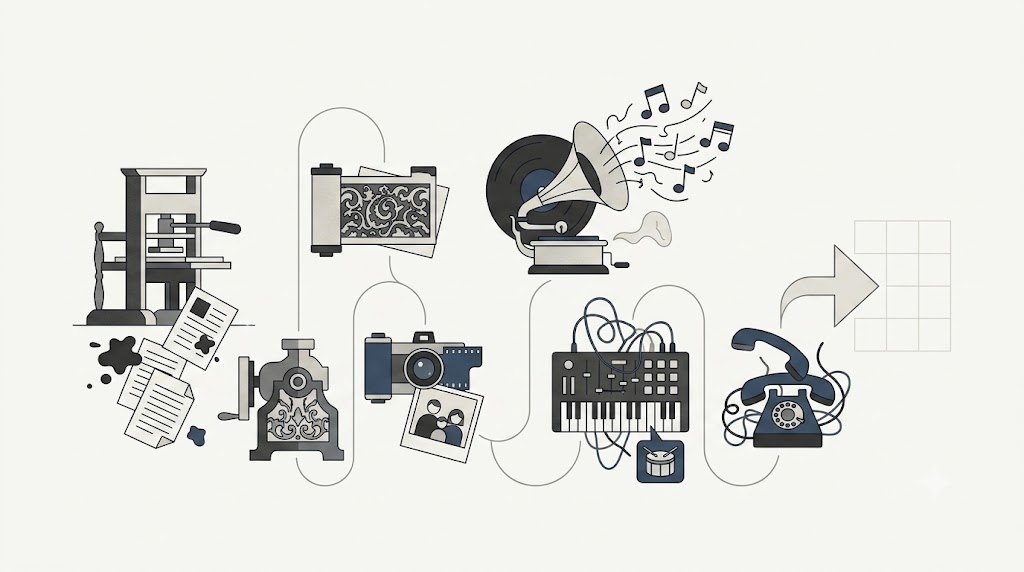
Six centuries, six technologies, one law. From Venetian printing presses to $3.95 telephones, every new tool escapes its guild, floods the world with bad output, and then goes invisible.
In 1976, you could rent a telephone shaped like a mouse. It had white gloves and yellow shoes, and Mickey Mouse held the receiver above his head like a trophy. It cost $39.95 per month and was, by any standard, a ridiculous object.
Henry Dreyfuss Associates, the design firm that gave the world the famous Model 500 desk set, drew it. The phone was sold alongside Snoopy, Winnie the Pooh, and a fake candlestick.
Why would a company with a legal monopoly, a twenty-year engineering standard, and no competitors start selling phones shaped like cartoon mice?
Because it could already smell what was coming.
Slop
We have a word for cheap, abundant, low-effort output made possible by a new machine. In 2025, slop was named Word of the Year by both Merriam-Webster and the American Dialect Society.
The word is older than the machines. In Middle English, slop meant a mud hole. Later, it meant watery, low-quality feed for animals.
To call something slop is to say it was not made for you. It was made at you, in volume.
Humans have been accusing themselves of producing slop for about five hundred and fifty years.
We are good at it.
Venice, 1481
The first great slop panic did not concern the printing press. It concerned the people operating it.
Hieronimo Squarciafico worked as an editor for Aldus Manutius, the finest printer in Europe.
In 1481, he wrote that printing had fallen into the hands of unlettered men.
Within three years, a dozen book presses started operations, flooding Venice's book market with low-quality editions of previously hand-copied Greek and Latin classics.
The market had collapsed.
A Venetian monk named Filippo de Strata famously said, "The pen is a virgin. The printing press is a whore."
In 1492, the Benedictine abbot Johannes Trithemius composed De laude scriptorum (In Praise of Scribes), a passionate defense of hand-copying against the vulgar new machine. He argued that a monk copying scripture drew closer to God, and that parchment (a writing material made from animal skin) would outlast paper.
Ironically, he published his defense as a machine-printed book in 1494.
London, 1852
A civilisation organised around its disgust.
The Great Exhibition of 1851 flooded Britain with machine-made ornament, mass-produced wallpaper, and papier-mâché trays. Henry Cole mounted a counterattack.
At Marlborough House, he assembled an exhibition called Examples of False Principles in Decoration: eighty-seven everyday objects, each displayed with a label explaining its crime. "Direct Imitation of Nature." "General want of repose."
The press named it the Chamber of Horrors.
It was the first museum of slop. And it failed instructively.
The public did not recoil from the objects. They recoiled from Cole. Charles Dickens's magazine published a satire of the display in December 1852. The condemned wallpapers continued to be manufactured for decades.
The gatekeeper had assumed that people bought ugly things because they had not yet been told the rules. He had it backwards. People were buying, for the first time in the history of their class, things at all.
Rochester, 1888
Then the machine reached the hand.
George Eastman's Kodak camera cost twenty-five dollars and came with the film already inside. You pressed the button; the company did the rest.
Within a decade, a million and a half roll-film cameras arrived in amateur hands. New verbs entered the language: kodaking, kodakers. The newspapers settled on a name for the people wielding them, and it was not a compliment: camera fiends.
Early Kodak prints came back circular. A round crop hides the corners, where amateurs ruin photographs.
The most successful consumer technology of the nineteenth century shipped with a built-in anti-slop mechanism for concealing its users' incompetence.
Everywhere, 1906
In 1906, John Philip Sousa published "The Menace of Mechanical Music."
Recorded music, he warned, would end amateur playing. "What of the national throat? Will it not weaken?" he asked.
The reply from Columbia Phonograph's vice-president was harsh. If mediocre pianists vanished, he said, we would be spared the horrors of scales and exercises in every house and flat in the country.
Sousa's essay was not only about aesthetics. It was part of a coordinated campaign for what became the Copyright Act of 1909.
Before 1909, US copyright protected copies, and a record was legally not a copy. A record company could buy a single set of sheet music for a Sousa march, press thousands of discs from it, and owe him nothing.
The taste argument and the rights argument arrived in the same envelope, and the taste argument was the one printed on the outside.
The complaint about the new machine's worthless, mass-produced output threatened the people being paid by the old one.
London, 23 May 1982
Barry Manilow went on tour with synthesisers instead of a string section. The string players noticed.
On 23 May 1982, the Central London branch of the Musicians' Union passed a motion calling for an outright ban on synthesisers and drum machines.
In a different part of the world, teenagers were buying discarded drum machines and inventing hip-hop and techno "slop" on them.
America, 1984
Which brings us back to the telephone.
For most of the twentieth century, Americans did not own their telephones. They rented them.
The phone in your hallway belonged to a company called AT&T. It had been built by Western Electric, which AT&T owned, and leased to you by a local Bell company, which AT&T also owned.
Phone sets had the renting arrangement moulded into the plastic housing: "BELL SYSTEM PROPERTY. NOT FOR SALE".
The famous Model 500 desk telephone was built to last twenty years. It was, by any standard, a well-crafted phone and a good business. Every failure meant a van, a technician, and a wage; all on AT&T's side of the ledger.
In 1968, the Federal Communications Commission (FCC) voted six to nothing that AT&T could not forbid you from attaching your own equipment to the network.
Within a few years, the American market was full of cheap, low-quality telephones selling as low as $3.95. Instead of beige boxes, these phones came in strange colors and shapes. AT&T called such devices foreign attachments, and it argued that strangers' equipment would damage the network; a safety case, made on behalf of the public.
In 2000, a Hong Kong company called VTech paid $113.3 million for what was left of AT&T's consumer telephone business, and acquired the exclusive right to put the letters "AT&T" on a telephone. The AT&T phone you can buy today is made by the descendants of the slop.
Cupertino, 1985
The Macintosh shipped in 1984 with something no "cheap" machine had carried before: a screen made of pixels rather than characters, and more than one typeface.
The disaster required one more year and two more products. In 1985, Apple shipped the LaserWriter and Aldus shipped PageMaker.
Five hundred years of typographic craft collided with several million people who had just discovered that fonts were free.
The output acquired a name that survives as a technical term: the ransom note effect. Untrained users mixed all sorts of things, just because they could.
To lean in on the "slop" joke, early Macintosh system software included a bitmapped typeface by Susan Kare called San Francisco, whose entire design was the ransom note effect. Later, Microsoft commissioned a font called Ransom in 1992. The mockery became a product.
Beneath the mockery, an extinction. The International Typographical Union, one of the oldest craft unions in America, lost half its membership between 1984 and 1987. Over a hundred and fifty thousand typesetting machines had been sold in the preceding decades. Between 1985 and 1995, the typesetting trade essentially ceased to exist.
How did the ransom notes stop?
Not through regulation, and not through shame. Through a paperback. In 1990, a writer named Robin Williams published The Mac is Not a Typewriter, a short book explaining smart quotes, kerning, leading, widows, and orphans. In 1994, she followed it with The Non-Designer's Design Book, which taught several million people the rules of good typography.
That is what the end of a slop era looks like. Not a ban. A grammar, cheap enough to buy at an airport.
The law
Six centuries, six technologies, one law.
First, a tool escapes the guild that owned it. Not a better tool, usually a worse one, judged by the guild's own standards.
Second, the volume explodes and the median output is genuinely bad. This is not a misperception by snobs. The $4 telephone really did break. The ransom-note newsletter really was unreadable. The critics are describing something true.
Third, a grammar arrives, from a rulebook, from a market that stops rewarding failure, or simply from a generation that grew up with the tool and never had to unlearn anything. And then the tool goes invisible, which is the highest status any technology can achieve.
Watch the vocabulary across the whole sequence: unlettered men. False principles. Camera fiends. The national throat. Loonies. Ransom note. Pigswill. The complaint is rarely about quality. It is about who is allowed to make things, dressed in the language of quality.
Ultimately, the tools matured. The crafts did not. The scribes did not come back. The typesetters did not come back. The string players did not come back. And the twenty-year telephone never came back either.
The pattern is simple: the technology survives its slop era, and the guild does not. Both halves are true, and only one of them is comforting.
Written in 2026, with the help of a machine that is currently producing several million pages an hour, most of them bad.
Sources
- Washington Post, "Consumers Hang Up on Disposable Phones," 26 Feb 1985 — the $3.95 phones, the 20-year engineering standard, the 18-month correction
- FCC, Use of the Carterfone Device in Message Toll Service, 13 FCC 2d 420 (1968); Part 68 adopted Oct 1975
- Wikipedia / The Henry Ford Museum on AT&T's Design Line telephones (1973–), incl. Mickey Mouse and Snoopy sets
- TWICE and Electronics Weekly, Jan 2000, on VTech's $113.3m purchase of Lucent Consumer Products and the AT&T brand licence
- Squarciafico (1481) and Filippo de Strata, via standard histories of the Aldine Press
- Johannes Trithemius, De laude scriptorum, written 1492, printed 1494
- V&A Collections and V&A blog on Henry Cole's False Principles in Decoration, Marlborough House 1852; Dickens's Household Words, Dec 1852
- Metropolitan Museum of Art, "Kodak and the Rise of Amateur Photography"; V&A on circular print format
- John Philip Sousa, "The Menace of Mechanical Music," Appleton's Magazine, Sept 1906; Patrick Warfield's scholarship on the 1909 Copyright Act link
- The Musicians' Union: A History (1893–2013), muhistory.com, on the May 1982 Central London branch motion
- WhatTheyThink, "The day the typesetting industry died"; The Conversation on ITU membership collapse 1984–87
- Robin Williams, The Mac is Not a Typewriter (1990) and The Non-Designer's Design Book (1994)
- Merriam-Webster and American Dialect Society, Word of the Year 2025

 Try pipe0