· Sales data · 4 min read
How to Choose the Right Data Enrichment Vendor in 2027
17 of 20 providers we've looked at claim to have the best data. So, how do you choose a data enrichment vendor that is right for you? We lay out a benchmarking architecture that has served us well at pipe0.

For this blog post, we looked at 20 B2B data vendors. 17 claimed to have the best data. Triple-verified emails, trusted phone numbers. Trust me, bro.
All but two providers in our test were cheap datasets resold at a premium.
In this blog post, we want to lay out our benchmarking infrastructure to empower you to evaluate B2B data providers with confidence.
Following this guide will require some work on your part. Feel free to reach out to us. We're happy to share the results of our benchmarks with you.
Either way, we encourage you to run your own benchmarks.
Why do all vendors claim to have the best data?
Vendors have four mechanisms to compete with each other.
- Coverage: For how many of your requests is data returned?
- Accuracy: If data is returned, how often is this data true?
- Cost: What is the cost of a successful enrichment?
- Speed: If data is returned, how fast is it returned?
Since there are so few ways in which vendors can differentiate, they typically claim superiority in all. After all, vendors are use to not being benchmarked.
And you are used to receiving bad data.
Why so few vendors have good data
The cost of calling yourself a data provider has fallen in the last years. An entire industry has formed around selling large bricks of static data that providers are allowed to resell.
Less sophisticated providers only add their marketing and logo before taking this data to the market.
In consequence, most data providers source from the same 5-8 standard data sources: Corsignal, Mixrank, BightData, Crustdata, People Data Labs, and a few others.
There are exceptions. Spotting them is hard.
Lesser known dimensions that matter
Next to the previously listed dimensions there are a few more that matter:
- Stability: How stable their service and API is. Unfortunately, most vendors are pretty unreliable.
- Permanence: Datasets drift. Fast. A vendor may have a good dataset when you first benchmark them. If they do not have the muscle to maintain it, their data will drift and deteriorate.
- Compliance: There are various regulations around B2B data. Sourcing data responsibly will protect you and your company.
Warning signs
Before going through the trouble of benchmarking a provider, here are a few warning signs that may help you decide if it is worth benchmarking a provider in the first place.
Embedded waterfall providers with a large number of low-cost providers
Embedded waterfall providers are providers that chain multiple providers into a cascade to increase the coverage of the enrichment. A few common waterfall enrichment providers are FullEnrich, Surfe, and BetterContact.
If you look through their provider list and see a large number of providers that commonly appear on the lower end of the price spectrum like Findymail, LeadMagic, Icypeas, Prospeo, Lusha, etc., it can be a warning sign.
We've extensively benchmarked these providers and found that their coverage and accuracy cannot compete with more established providers. Even worse, we found that almost all cheaper providers source from the same datasets and typically overlap by more than 99%.
Chaining multiple of them into a waterfall is pointless. Please believe us. We've tested this over and over so you don't have to.
Do they have developers on their team that you would trust?
Quickly check their LinkedIn page to see if they have experienced developers on their team.
Book a demo and question them on the quality of their data
If providers get defensive or refuse to give you an honest, balanced assessment of their strengths and weaknesses, this is usually a bad sign.
Setting up benchmarks
Source a dataset
Curate a dataset that is representative of the enrichment you want to perform. Ensure some geographic variety as well as variety in the professions the people in your dataset have.
Be aware that most providers source their dataset from LinkedIn. If you're trying to enrich a demographic that is not commonly represented on LinkedIn, make sure your benchmarking data reflects this.
A good sample size is 1000 records. But after running hundreds of benchmarks, we can confidently say that we've never seen a provider improve past what we've seen after 100 records or so.
Dimensions to test
After you've compiled your dataset, create your benchmarks as a visual app or as a command line utility. Here is what we recommend you test.
Coverage
This is by far the easiest metric to test. You run your dataset through the enrichment and see for how many requests data was returned.
Accuracy
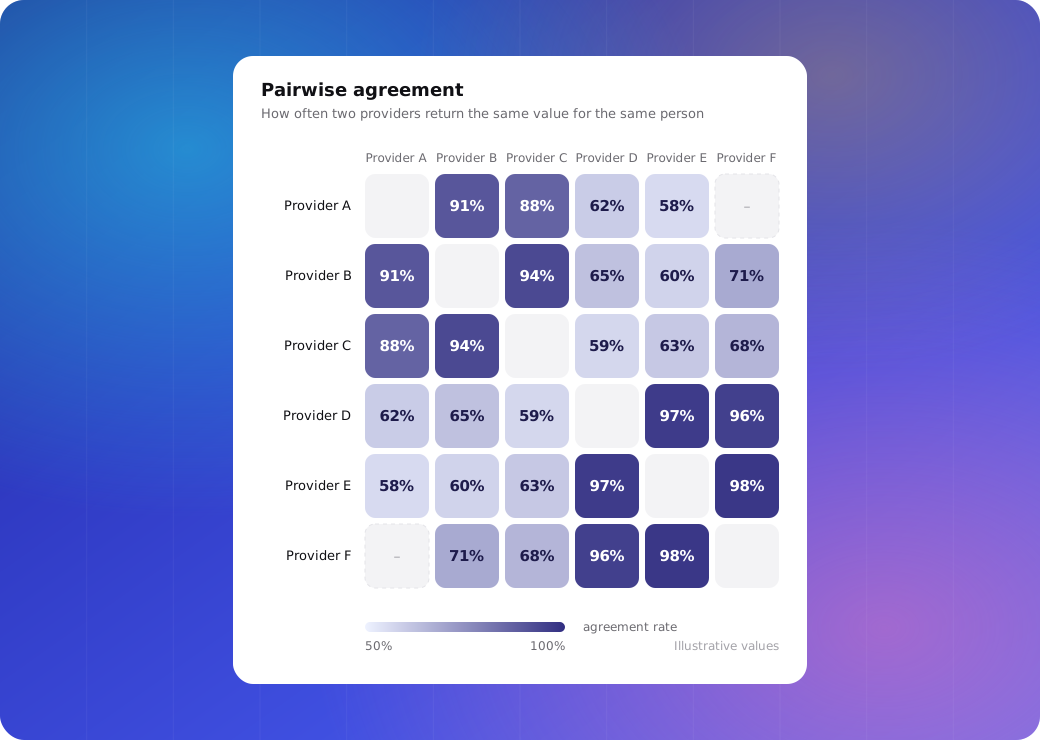
This is by far the hardest metric to test. At pipe0 our primary metric for accuracy is agreement with trusted providers. For this we run the same dataset through different providers. We then build a grid, checking how often different providers agree with each other. We log every case where they disagree and inspect it manually, trying to determine which one is more accurate.
Latency
A simple stopwatch at the beginning and end of each test.
Dataset uniqueness
During your benchmark, one of the most effective metric to measure cost performance of a vendor is to run the same dataset through multiple providers and measure how many values were found exclusively by each vendor.
This metric will also help you design custom waterfalls where each vendor has a unique contribution to your overall coverage.
Frequently asked questions
How do I evaluate a B2B data enrichment vendor?
Benchmark it rather than trusting the marketing. Vendors compete on four dimensions: coverage, accuracy, cost, and speed. Two more matter over time: how stable their API is and whether they maintain their dataset, since datasets drift fast. Run a representative sample of your own records through each vendor and measure.
Why do all data vendors claim to have the best data?
Because most of them are not the source of their own data. Many vendors resell datasets at a premium.
How large should a benchmarking dataset be?
A good sample size is 1000 records. In practice, results rarely change after the first 100 or so.
How do you measure the accuracy of enrichment data?
Accuracy is the hardest metric to test. One workable method is agreement between trusted providers: run the same dataset through several vendors, build a grid of how often they agree with each other, and manually inspect every case where they disagree to decide which one is right.

 Try pipe0