· Sales data · 3 min read
High-Volume Data Enrichment Without Breaking the Bank
Running data enrichment at scale has many challenges. Rate limits and cost are the two biggest ones. Both can be solved.
Data enrichment is often done over a small dataset. You isolate a few hundred users, find their email addresses, and some information about their company. For this kind of enrichment, meta providers like Clay shine.
The situation is different as things get larger.
Suddenly, you have to worry about the overall throughput and rate limit of your system. Additionally, cost becomes a major concern.
Why credits stop working at volume
Meta providers like Clay sell one currency: a credit. This credit has a certain value. Let's say it is around 3 ct. for a USD 149 / mo subscription and 1 ct. for a USD 999 / mo subscription.
Industry practice is to charge a lower price per credit the more you spend.
However, meta-providers sell you credits without knowing what you will spend them on. You may spend all your credits on email lookups. Or you may spend all your credits on ChatGPT tokens.
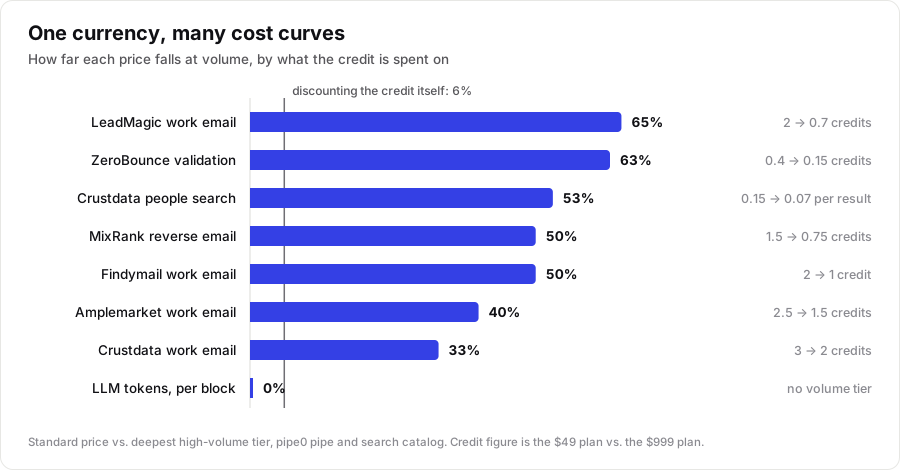
However, both of these assets scale very differently. When buying directly from a provider, it is common that the price for an email lookup falls by 10-20x. This depends on the volume that you purchase.
AI tokens, on the other hand, do not fall in price the more you purchase. Here, the price stays fixed. It does not matter if you purchase 1 token or 1 trillion from OpenAI.
This is a classic forecasting problem. To not lose money on customers, meta providers tend to overcharge by 12-15x for emails and phone numbers. They do this just in case you spend your credits on an asset that scales badly.
Since almost everyone in the meta provider industry follows this exact playbook, users have few places to go other than to the providers directly.
This prompts large companies and agencies to purchase licenses with data vendors directly and use self-managed API keys.
Meta providers like Clay reacted to this change with a pretty drastic cost increase for users who use Clay this way. Instead of fixing the underlying problem, they drastically increased the cost of performing an operation with your own API key.
The logic explains why single-purpose vendors like FullEnrich work.
With a product that is focused on contact enrichment only, they can model their product to follow the volume-based discount strategy of the providers.
Bringing your own key does not make things better
When reading the argument above, it's easy to think that this problem can be solved by making it easy for users to bring their own API keys.
This is a valid assumption and the strategy of platforms like n8n.
But managed keys have several advantages. They:
- are more reliable and have higher rate limits
- run into fewer issues because they are isolated
- prevent you from having to manage X credit balances
- make more providers available to you
And these advantages are just what you give up when using your own keys on platforms like pipe0 or Clay. If you choose to build the entire orchestration yourself, you have to think about conventional programming problems: normalizing rate limits, provider responses, dealing with outages, etc.
So, how can you make use of the advantages of meta providers while being charged fairly?
Discount the operation, not the currency
We've come up with a unique pricing strategy that discounts the operation, not the currency.
The cost of a credit stays linear. It is roughly 3 ct. / credit.
Instead of cheaper credits, you receive more high-volume slots with more spend.
For operations that reduce in cost with volume (e.g., email lookups) we offer discount brackets.
For operations that don't reduce in cost (e.g., AI tokens), we do NOT offer discount brackets.
Conceptually, this is 1:1 the same as purchasing a custom API key at a higher tier from a provider directly.
If you're performing operations at a high volume, like finding email addresses or phone numbers, opt for
a lower price. You can change your enrollment once a month or configure auto-mode where pipe0
optimizes your enrollments based on historical usage.
With this billing scheme, pipe0 users operate 10-12x more cost-effectively compared to Clay. The cost per enrichment remains competitive with self-managed API keys. All while maintaining the benefits of a meta provider.

 Try pipe0