· Sales data · 4 min read
Clay vs ZoomInfo: Which One Do You Actually Need?
ZoomInfo and Clay are two of the most expensive data enrichment providers on the market. Their data quality and accuracy struggles to back what they claim. If you must choose between the two, here are some facts.
Clay and ZoomInfo get compared constantly, usually because both show up as large line items in a GTM budget. They are different kinds of products. One is a traditional B2B data vendor, the other is a meta provider.
A database and a workbench
ZoomInfo owns its data. The company has collected contact records for over a decade. When you buy ZoomInfo, you buy access to one large, proprietary dataset, plus the tools built on top of it: org charts, intent signals, direct dials.
Clay owns almost no data. It is a meta provider: it resells access to 100+ external data providers and lets you compose them in a spreadsheet. We wrote about how meta providers work in FullEnrich vs Clay; the short version is that Clay chains providers into waterfalls, moving from one provider to the next until one returns a result.
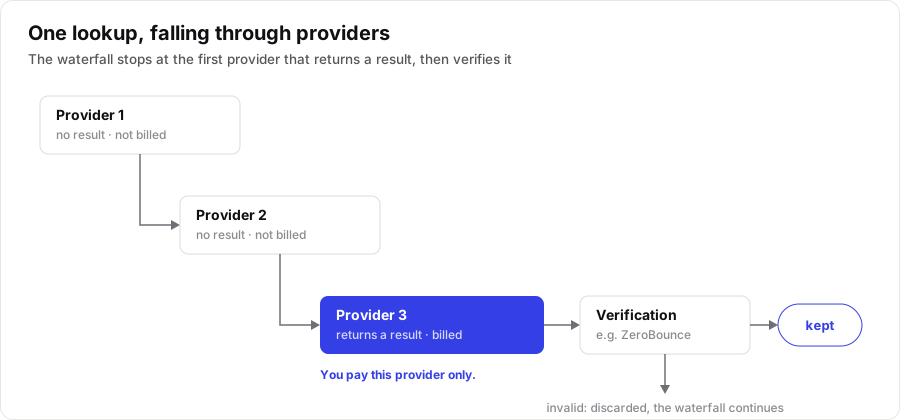
One database with one hit rate (ZoomInfo), or many databases stitched together (Clay).
Comparing on cost
ZoomInfo pricing roughly starts at $14,000 a year for three seats, and the median contract value sits at around $33,500 a year.
Contracts auto-renew, and cancellation requires 60 days' notice. Put the end date of your contract in your calendar (!). You may want to use it later.
Clay publishes its prices. After its March 2026 pricing change, the Launch plan costs $167 a month on annual billing and meters two separate currencies: data credits for enrichment and actions for every workflow step.
Most lookups that return nothing are free.
In a recent blog post, Clay admitted its old Pro tier had lost money for years, which is hard to believe given the extreme margins on the raw data.
| ZoomInfo | Clay | pipe0 | |
|---|---|---|---|
| Entry price | $14,995/yr, 3 seats | $167/mo, annual | $49/mo |
| Median real contract | $33,500/yr | not tracked | usage-based |
| What you buy | seats + credits | data credits + actions | credits |
| Public prices | no | yes | yes |
👉🏽 On pipe0, a found work email costs about 1.6¢ and a found phone number about 9¢, on plans starting at $49 a month. 3-12x more cost efficient than the two alternatives.
The data itself
ZoomInfo claims 95% accuracy. Do not plan around that number.
In the field, people report roughly 55-75% within strong segments.
Additionally, bounce rates hover around 15-25%. The misses concentrate where many teams prospect: startups, healthcare, anything outside the US. ZoomInfo's own docs concede the weak segments.
The decay is structural. ZoomInfo claims to refresh its database monthly. But the data has grown faster than anyone can verify.
"ZoomInfo has so much data, they sacrifice accuracy because they can't verify data changes."
The top answer in this Reddit thread says it best.
"It's not that it's dead, it's that it's too expensive for what it brings to the table. There's a whole crop of newcomers to the data / lead gen space that do it for a fraction of the cost."
Treat database size claims the same way. ZoomInfo's pages cite 500 million contacts; third-party counts land closer to 320 million. These are cumulative figures, not live ones, and B2B contact data decays at roughly 22.5% a year. The dataset is genuinely the deepest in US enterprise. It is not 500 million reachable people.
Clay sidesteps the staleness problem by not owning data at all. Coverage is the union of its providers, which holds up better outside the US. The tradeoff is margin: every provider in the chain charges its markup, and Clay charges its own on top.
However, if Clay can be described as wildly overpriced, ZoomInfo manages to "one-up" it.
If price is a concern for you, you won't be happy with either of the two.
Should you use either?
At pipe0, we benchmark enrichment providers for a living, and we have built enrichment systems at companies like Cursor and Cloudflare. Our reading:
ZoomInfo's time has come and gone. The data has decayed, the price has not. The contract is built to keep you. In 2026, almost everyone is better off with another provider. The one case left for buying it: you want a vendor that is established in the enterprise and can handle a large procurement process.
If you want a workbench for building lists, scoring, and custom workflows, buy Clay (👉🏽 or give pipe0 a try). It has the largest template library in the category and years of polish in the table UI.
Many enterprises buy both, which means paying ZoomInfo's margin and Clay's margin on overlapping capabilities. This is the outcome we would avoid. If what you actually need is coverage at a fair price, with a spreadsheet, an API, and agent access on the same engine, try pipe0.

 Try pipe0