· Sales data · 5 min read
The Best Data Enrichment Tools in 2026, by Category
Data enrichment tools find people and contact data. More than 400 providers exist today. Finding the right one is a challenging problem.
Data enrichment has become one of the core disciplines in sales and growth. Many of today's systems depend on it:
- Prospecting new leads and finding their contact data
- CRM enrichment
- Signal engines
- Building sales automations
In data enrichment, we differentiate between two types of systems.
B2B contact data
B2B contact data providers are simple databases returning email addresses and phone numbers. Sometimes these systems work with a single database. Other times they run the same lookup through several providers in sequence until one of them hits. That motion is called waterfall enrichment.
Best B2B contact data providers
Surfe – waterfall enrichments made in Europe
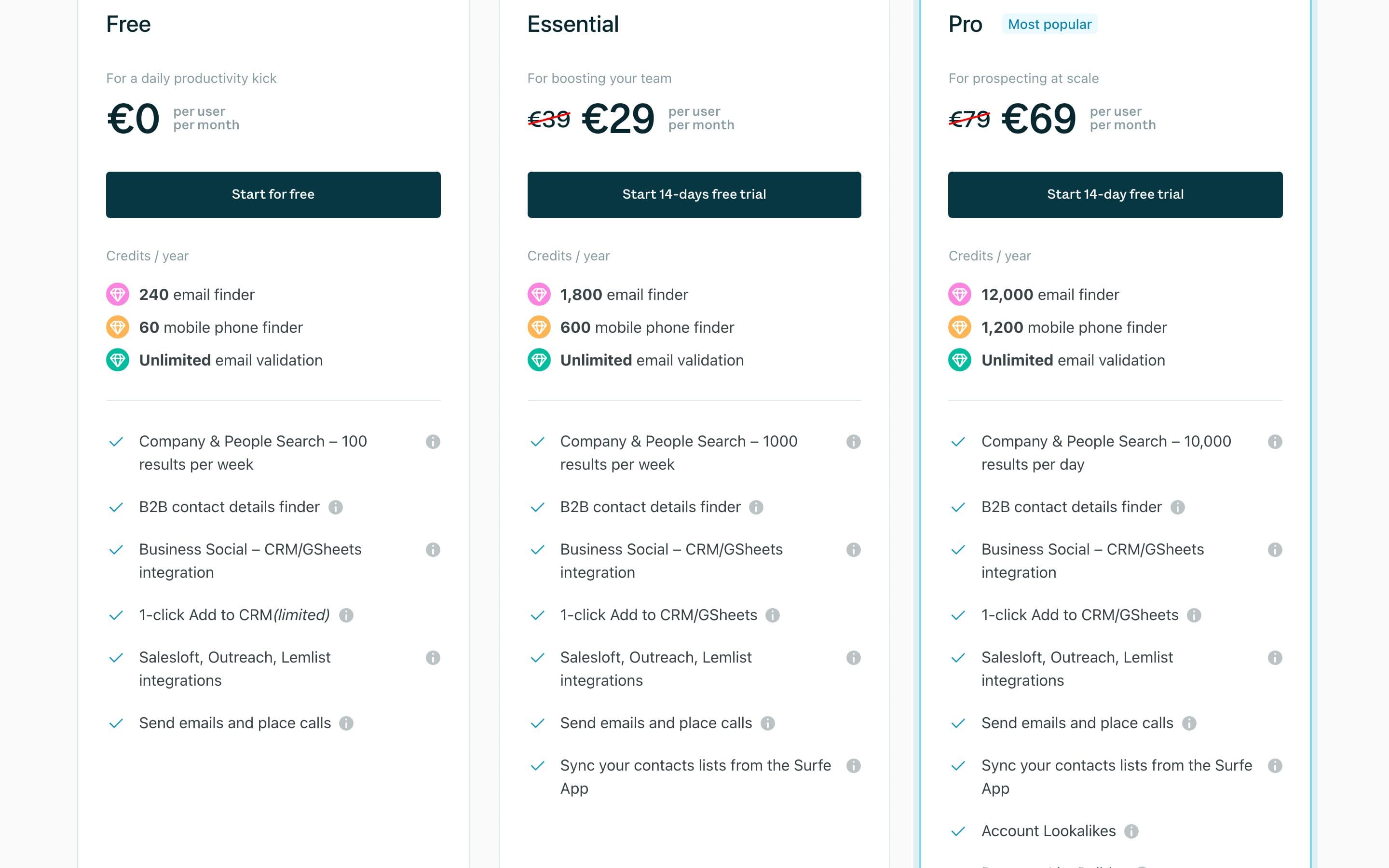
Surfe is a B2B data provider similar to FullEnrich.
- Starting price: €29/user/month billed annually (€39 monthly); free plan available
- Work email: €0.07 per found email
- Mobile number: €0.36 per found mobile
Pros:
- Unlimited email validation on every plan, including the free one
- The GDPR-compliant lookup mode is a real answer for EU teams
- Good coverage for emails and phone numbers
Cons:
- Per-seat pricing
FullEnrich – waterfall enrichments
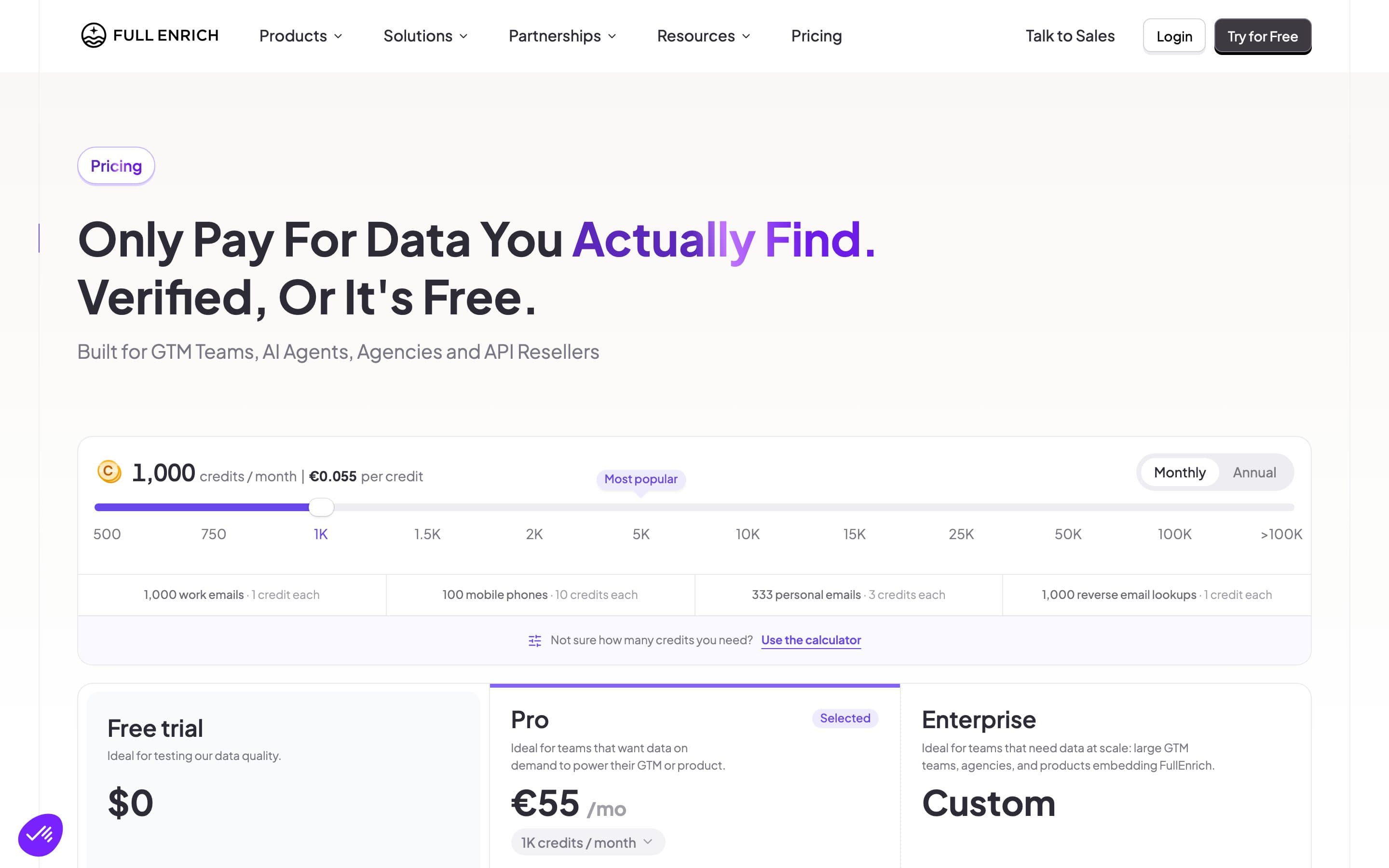
FullEnrich is the specialist: a waterfall of 20+ vendors that finds emails and mobile numbers, and nothing else. One credit buys a found work email, ten credits for a found mobile. Failed lookups cost nothing.
- Starts at $29/month for 500 credits (free trial with 50 credits)
- Work email: $0.055 per found email
- Mobile number: $0.55 per found mobile
Pros:
- Published, predictable per-unit prices; unlimited seats share one pool
- Credits roll over 3 months on monthly billing, 12 on annual
- Particularly strong on phones, with US and Canada ownership validation
Cons:
- Catch-all emails are billed as found, and unresolved catch-alls carry real bounce risk
- Emails and phones only; everything else needs a second tool
- Expensive for what it does
LeadMagic – affordable contact data
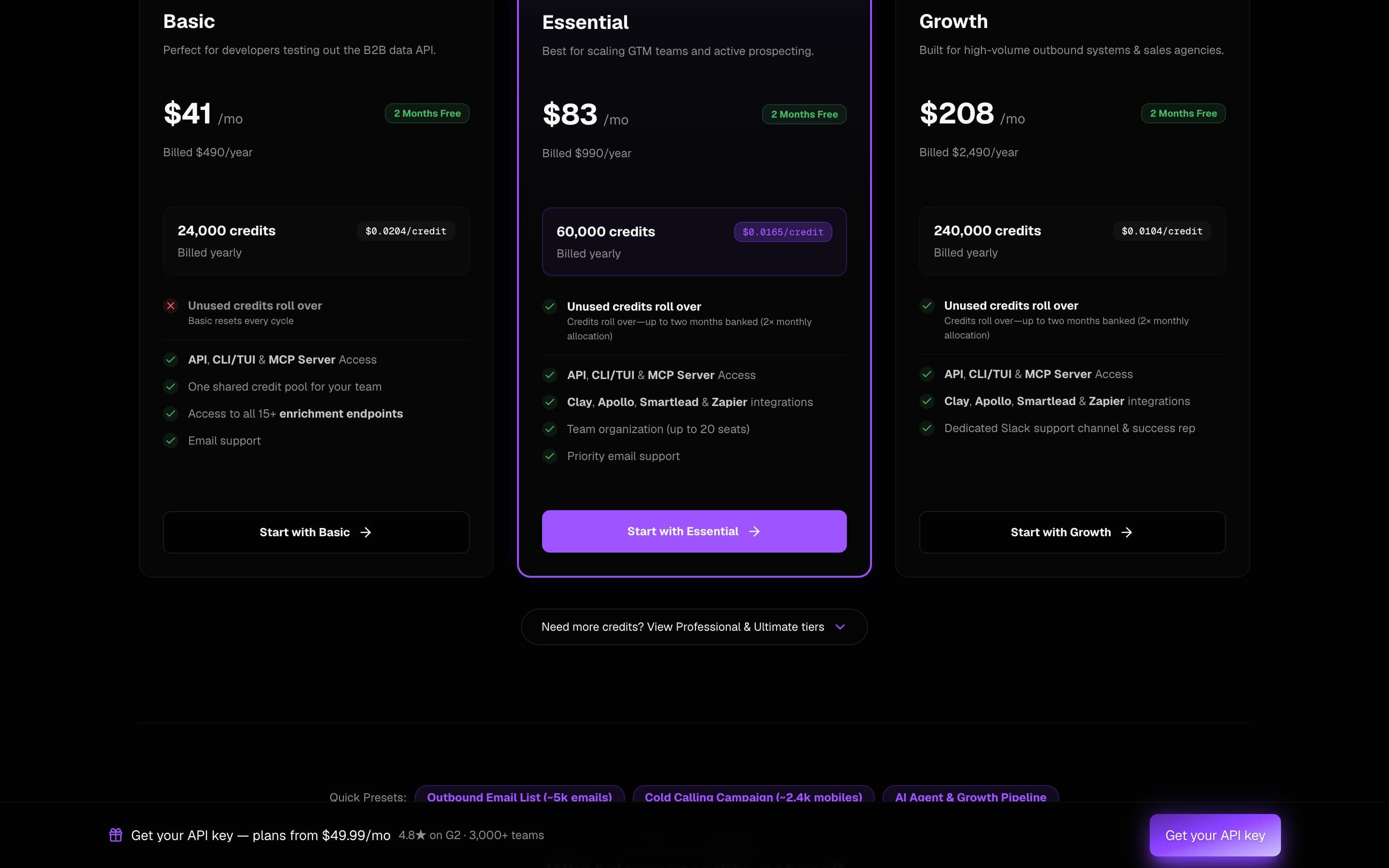
LeadMagic is an API-first enrichment layer with 18 REST endpoints.
- Starting price: $49.99/month for 2,000 credits (100 free credits, no card)
- Work email: $0.025 per found email
- Mobile number: $0.125 per found mobile
Pros:
- The cheapest published mobile rate in this list, falling to about $0.04 at the top tier
- Credits roll over on Essential and up, banked to twice the monthly allocation
Cons:
- Coverage is thin for both emails and phone numbers
- No state-of-the-art user interface
Data orchestrators
A more interesting category, however, is tools that not only allow you to fetch contact data but let you perform enrichment, actions, and logic.
These tools allow you to search, enrich, and qualify in one motion.
Here's an example: You start by searching for a list of every CEO in New York City. The list contains 10,000 prospects. Then you use enrichment to fetch their LinkedIn profile. Next, you exclude CEOs who don't work for a tech company.
The list shrinks to 5,000 users. Next, you fetch the most recent LinkedIn posts of every user on this list. If they have posted about AI, you qualify them. For every qualified CEO, you fetch their phone number and add them to a sequence.
Best data orchestrators
pipe0 – 50+ providers with one interface
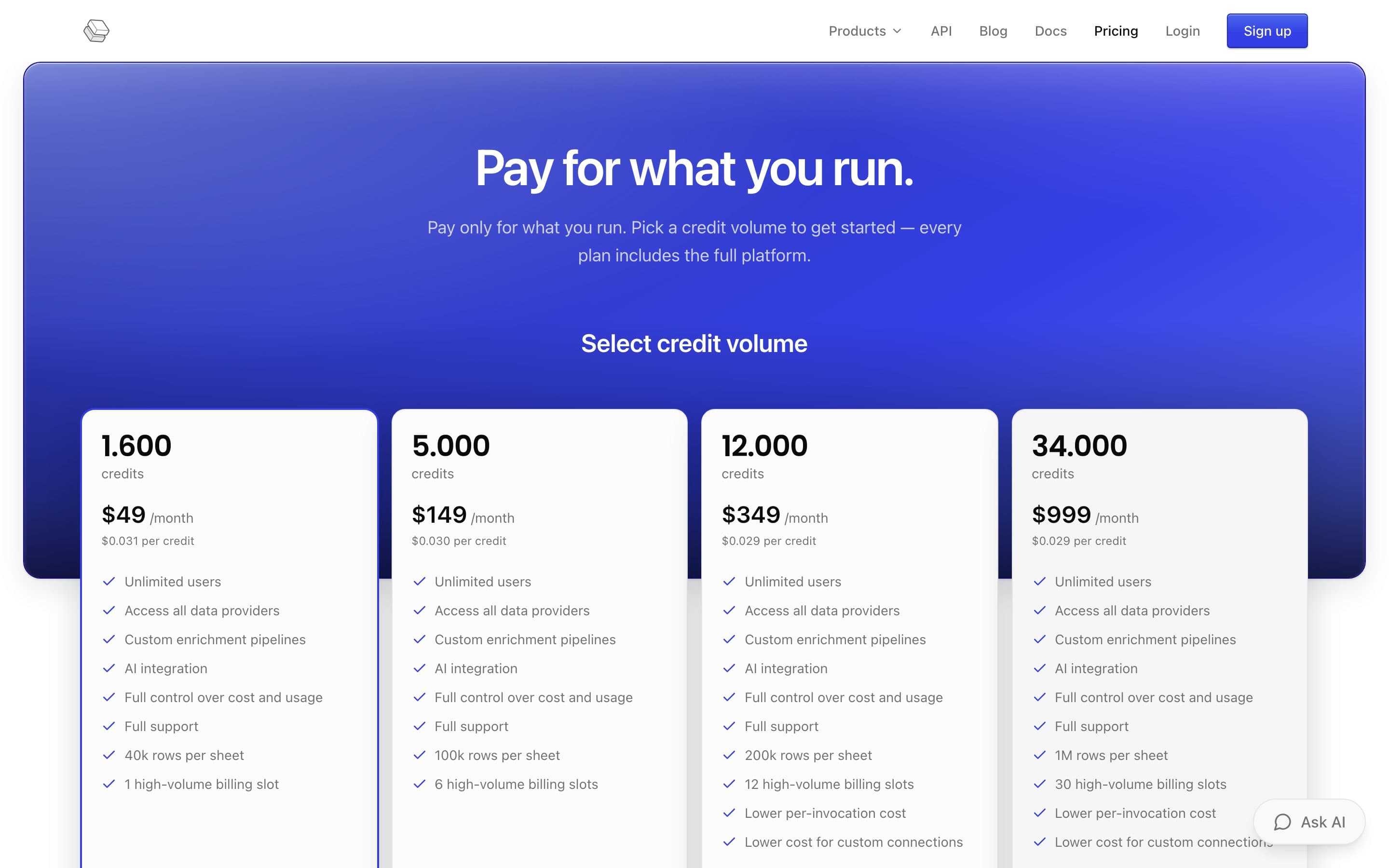
Pipe0 is a modern, AI-first data enrichment platform with great coverage and leading cost efficiency.
It is the only tool in this category with a full API and an MCP server. Its tables can hold up to 2M records. Conveniently, tables in pipe0 can be point-in-time restored, a feature that is missing in comparable tools.
Data moves freely between the MCP server, the API, and sheets, so agents and humans work on the same rows. Everything can be scheduled and turned into automations.
- Starting price: $49/month for 1,600 credits
- Work email: $0.02 per found email
- Mobile number: $0.08 per found mobile
Pros:
- 3-10x more cost-efficient than traditional tabular tools
- Bring your own API keys and use the API on any plan
- Sheets, API, and MCP are one engine, not three bolted-together products
Cons:
- Fewer templates and smaller community
- No native sequencer; it integrates with the common ones instead
Clay – Revenue system orchestration
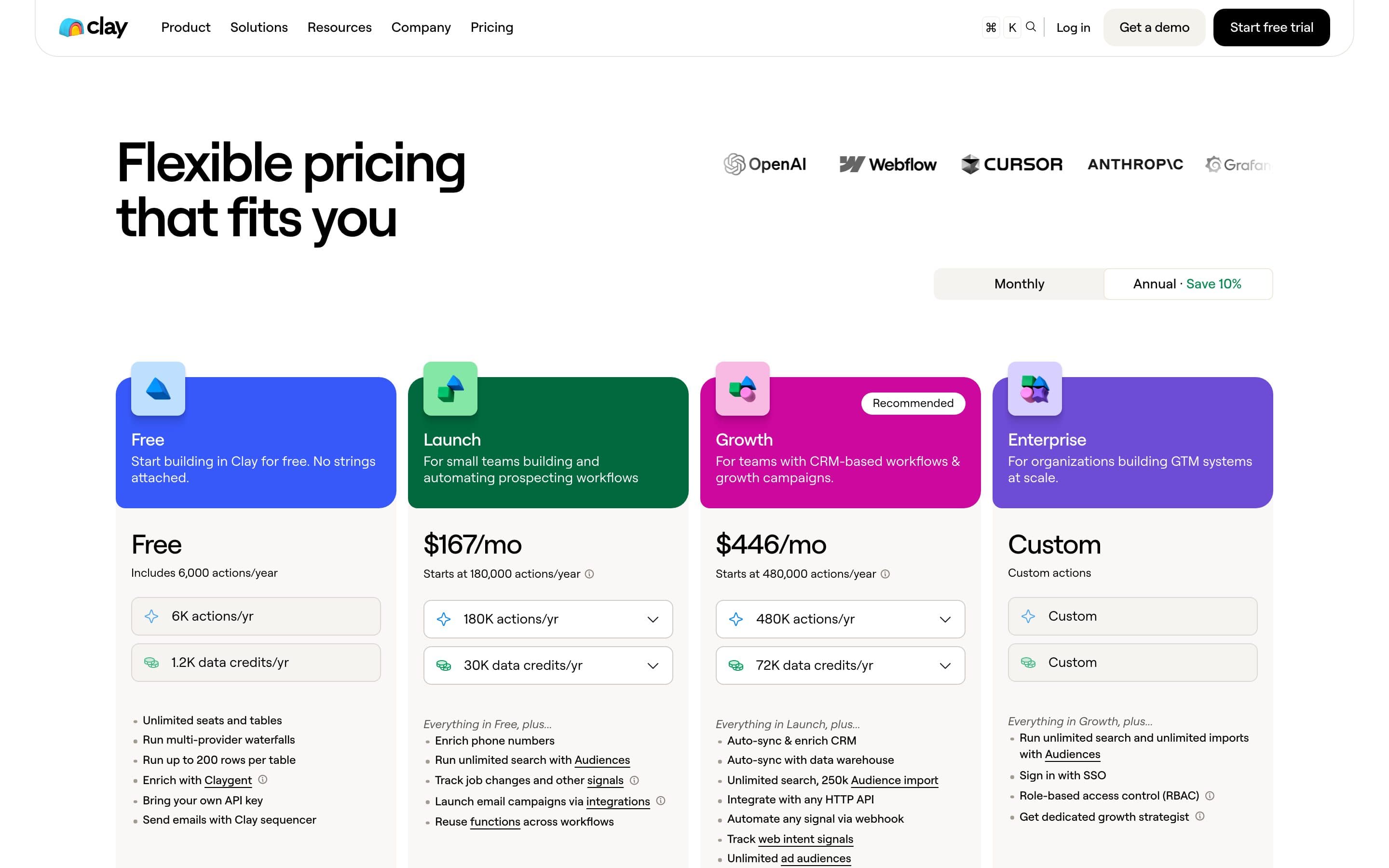
Clay has defined this category since 2017: a spreadsheet where every column can call one of 150+ data providers, an AI research agent in Claygent, and, since July 2026, a public API, CLI, and MCP server on all plans. The March 2026 repricing split billing into two currencies, actions for orchestration and data credits for purchased data, and that split is the main thing to understand before you buy.
- Starting price: free plan; paid from $167/month billed annually ($185 monthly)
- Work email: $0.25 per found email through a waterfall
- Mobile number: $0.75 per found mobile
Pros:
- The largest provider marketplace and largest community
- The free plan includes unlimited seats
Cons:
- Two currencies plus a 30% top-up premium make costs hard to forecast
- Actions expire monthly and don't roll over
- Extreme prices
- Practitioners measure the learning curve in weeks
- No working AI agent (Sculptor has not worked for us, ever)
- Many features hidden behind enterprise plans
Cargo – node-based enrichment
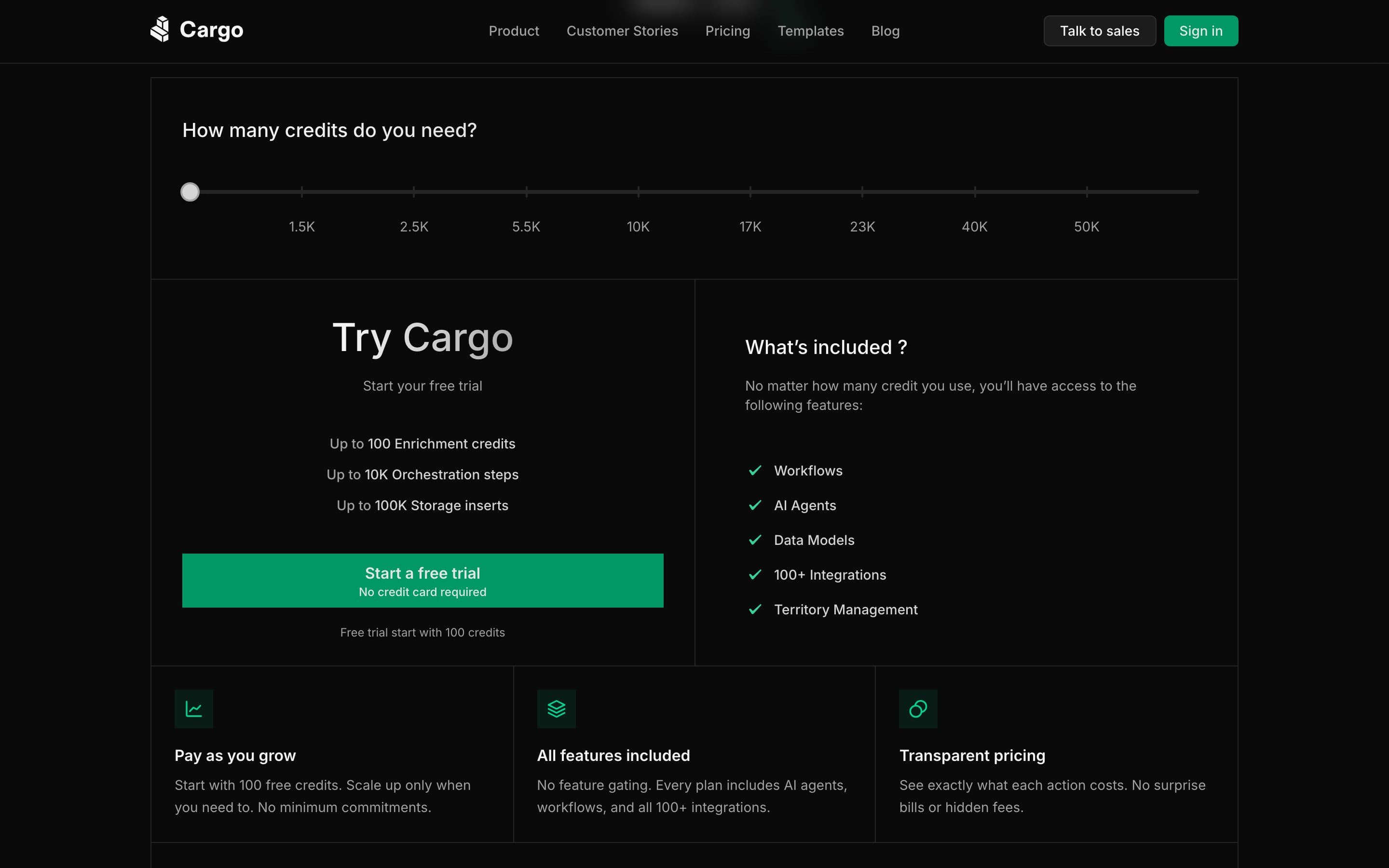
Cargo sits closest to the data warehouse: a node-based workflow builder with AI agents for research, qualification, and SDR work, on top of 100+ integrations. You wire sources, enrichments, and actions into graphs, and the agents run inside them.
- Starting price: From $165/month for 1,500 credits
- Work email: $0.16 per found email
- Mobile number: $0.65 per found mobile
Pros:
- No feature gating: agents, workflows, and SSO on every tier
- Top-ups and overage at plan rates, with no premium
- Orchestration steps are moderately priced, at 1 credit per 100 steps
Cons:
- Three billing meters (enrichment, orchestration, storage) to forecast
- Many workarounds because the core data model does not scale
- Around 15-20 data providers, compared to Clay's 150+
- Almost no public reviews to sanity-check quality against
- High prices

 Try pipe0